Finding Happiness in the Mundane
Somewhere after entering the working world, the days start to lose their edges. Nine to six, then home to the same small chores, a scroll through the phone, and somehow the evening is gone with nothing much to show for it. Weekends slip by before they announce themselves, and Monday returns before the rest ever really lands. Life settles into a quiet loop of small, forgettable tasks, one day folding neatly into the next.
There was a different kind of happiness in childhood. A smooth stone found on the ground, a small sweet that tasted better than it had any right to, the smallest things were enough to carry a whole afternoon. That kind of joy grows scarcer with age, scarce enough to wonder whether it was ever meant for grown-ups at all. But the loss has less to do with having less. Children simply haven’t yet learned the one rule that adulthood quietly installs, the rule that happiness has to be earned, that something must first be reached before joy is allowed.
That rule came undone on an ordinary walk around Jurong Lake.
An Unremarkable Zone 2
It began casually enough. A conversation with a good friend about Zone 2 training, about what it does for the heart and the body, was enough to spark some curiosity. July seemed like a reasonable place to start, and Jurong Lake seemed like a reasonable place to walk, a small habit worth folding into the week.
The start was less than smooth. Two brisk walks in, and the Apple Watch refused to budge past Zone 1, no matter the effort. An old ankle injury and a backpack ruled out anything resembling a run. It was easy, at the time, to offer up a flattering explanation, that perhaps all that Muay Thai had built up the cardio, and walking alone could no longer push the heart rate high enough.
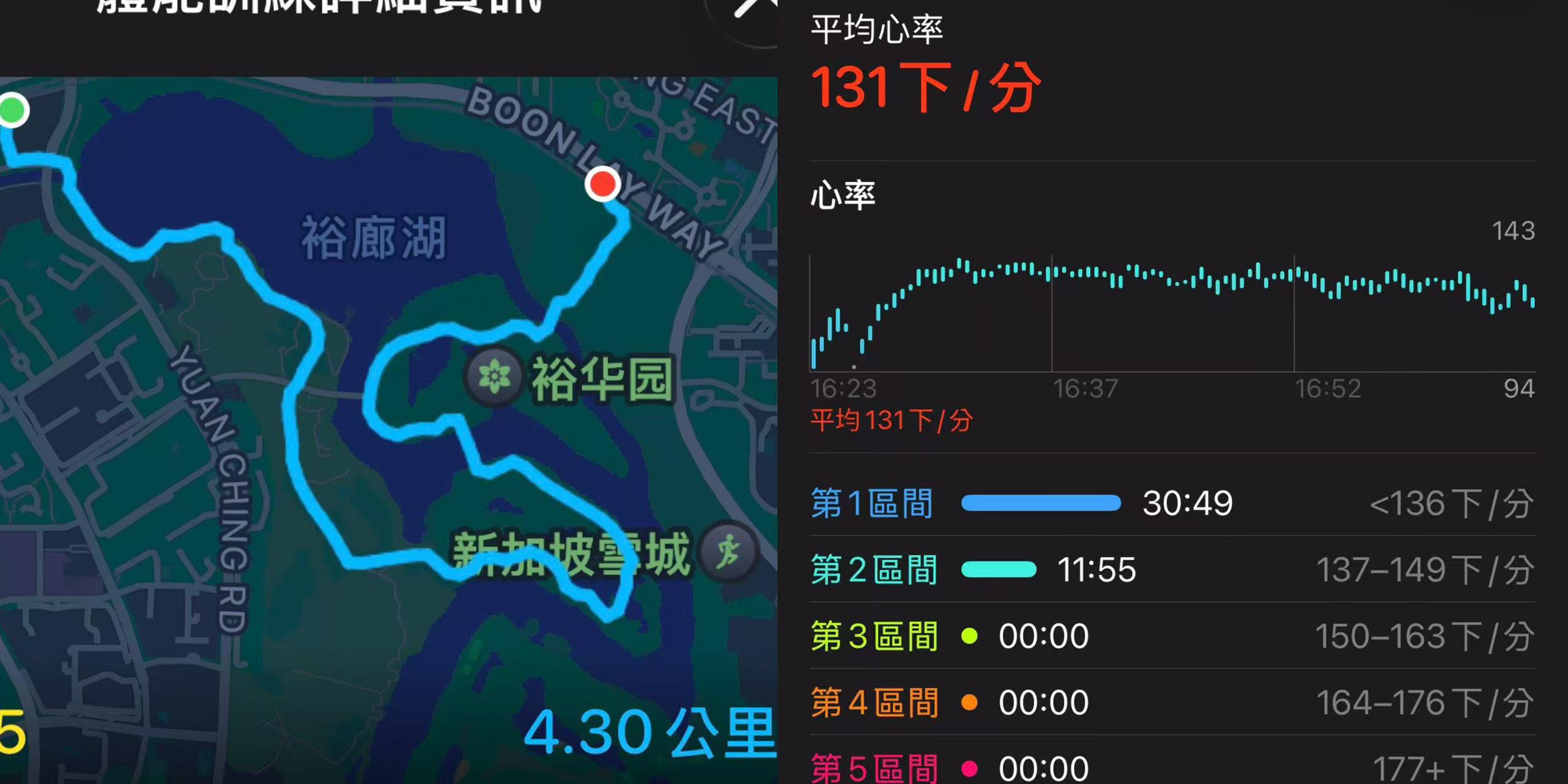
A week later came another attempt. For no obvious reason, the pace came in a little faster than before, 10’19 down to 9’56, with an average heart rate settling around 131 and a peak near 142. The watch finally logged it as Zone 2.
The moment it registered brought a flush of satisfaction. And yet, a few steps further along the path, something odd surfaced. The happiness was real, but the reason behind it refused to name itself. What reaching Zone 2 was supposed to deliver remained genuinely unclear. There was no particular meaning attached to the number, only the reflexive pleasure of having hit a target that had been set somewhere, by someone, for some reason.
Always Chasing, Rarely Knowing Why
That small confusion lingered longer than expected, and it turned out not to be a private problem at all.
Adult life seems to run on a permanent chase toward some goal, and often enough the goal outlasts any memory of why it was chosen. The familiar versions are easy enough to list, the first real savings, a bigger place to live, the car that was always wanted, the next rung on the ladder. There is a persistent sense that arriving at any one of them will tilt everything into place, that happiness waits just past the finish line. So joy gets staked on one threshold after another, though many of those thresholds were never truly needed. They were simply the things everyone agrees are worth chasing.
Look a little closer and two rather deflating truths come into view.
The first is that human beings appear built never to stop. Wanting more was, for a long stretch of evolutionary history, the thing that kept the species alive, which means dissatisfaction sits close to the core. Contentment keeps getting pushed down the road. The second is that arrival tends to disappoint even when it comes. The thrill fades quickly. The excitement of a raise or a new home usually dims within a few months, and the eye drifts upward to the next target almost immediately. Framed that way, the whole logic of “once I reach this, I’ll be happy” reveals itself as a treadmill with no off switch.
The Zone 2 moment fit the pattern exactly. A target met, and no clear account of what it had actually given. Which pointed, in the end, toward a single conclusion, that happiness was never waiting at the finish line to begin with.
So Where Does It Live
If not at the moment of arrival, then perhaps it had been there all along, buried under the constant forward motion of the chase.
The suspicion runs something like this. When the pile of must-reach goals thins out, when joy stops being wagered on the next threshold, happiness tends to surface on its own. That path around the lake was where the idea first showed itself. What followed was an attempt to gather a few ways of loosening happiness from its usual hooks.
Notice the small improvements.
The satisfaction never really came from the words “Zone 2.” It came from the fact that last week the number wouldn’t climb and this week it did, a small piece of growth that belonged to no one else. Somewhere along the way of growing up, the habit sets in of measuring oneself only against the finish line. Work becomes the year-end review and the line marking a promotion; money becomes the distance still left before the account hits a certain figure. The gaze stays fixed on the ground not yet covered, and every step already taken blurs into something too small to count. A great deal of road gets walked, yet the feeling of standing still persists, because the yardstick is always that distant, untouched point.
Happiness lives in the opposite direction. Face the finish line and the arithmetic is always about the shortfall, a lack that never quite fills. Turn around, and the arithmetic becomes how far the road has already carried you, a gain that cannot be taken back. Goals fall through; distance walked does not. What wears a person down is rarely the effort itself, but the sense of pouring everything in without ever seeming to move, and looking back at real progress quietly overturns that stall. The capacity lost in adulthood is exactly this backward glance. The thing worth practising is not fixing both eyes on the end, but pausing now and then to see how far the walking has already gone.
Drop the meaningless “shoulds.”
A single week fills up with all kinds of “shoulds.” The social event attended purely to belong. The book bought because it was supposed to be important, now half-finished and radiating a faint guilt each time it catches the eye. The online course signed up for because everyone else seemed to be taking it, still nowhere near complete.
These “shoulds” share one thing in common, which is that the standard behind them was never set from within. It was borrowed from outside. The question rarely gets asked out loud, whether a given thing is actually wanted, or simply something “a person like me is supposed to do.”
Their real cost runs deeper than the hours they consume. A task agreed to but not wanted becomes a notification left running in the background, a low and constant guilt. It never gets crossed off the list, yet never quite gets done either, and so it hangs there, slowly draining. Letting it go brings a happiness that has nothing to do with “finally having free time” and everything to do with a weight that no longer needs carrying. It feels like setting down a bag lugged around for years for no real reason. Strangely enough, a dull series abandoned halfway bothers no one, yet an unfinished book or a missed event can summon an oddly persistent guilt, one entirely self-imposed. Finding the nerve to drop the “shoulds” is not quitting halfway. It is admitting, honestly, that a thing holds no meaning, and reclaiming the time and attention from goals that were only ever on loan.
Move through your own time zone.
Somewhere in the process of growing up comes the habit of setting the reference point far away. The version of oneself expected at a certain age. The position widely agreed to count as “success.” The imagined finish line up ahead. With the marker planted out there, every step in the present becomes little more than proof of not having arrived.
This is where the trouble starts. When the ruler for measuring oneself is forever some point not yet reached, no amount of distance feels like anything but standing still, because the gap is always there, and the further the walking goes, the wider new horizons make that gap appear. Deprivation tends to creep in unnoticed, a long stretch of road already behind and a way of measuring that makes all of it look like nothing has happened yet.
Moving through one’s own time zone means trading that distant marker for something closer to the feet. Not “how far still to the end,” but “how far from where the walking began.” A life is both very long and very short. Long enough to fall and rise again, to take a wrong turn and loop back. Short enough that there is little room to spend it living up to a standard set somewhere far off. Once the reference point is drawn back from the horizon to the ground underfoot, the deprivation, that stubborn feeling of getting nowhere no matter what, finally begins to loosen.
The Permission to Arrive First
This particular feeling, it turns out, already has a name. Psychologists call it the arrival fallacy, a term coined by the Harvard positive-psychology scholar Tal Ben-Shahar in his book Happier. The idea maps almost perfectly onto the confusion on that path, the belief that reaching a goal, a promotion, a home, a certain number in the bank, means happiness will be standing at the finish line to greet you. It is, more often than not, an illusion. The rush of arrival rarely outlasts a season, and a new goal rises to take its place, pushing joy once more toward the next “once I get there.”
What tends to go missing in the passage to adulthood, then, is not happiness itself. It is the permission to let happiness arrive first, before reaching anywhere at all.